PLAN & BUY
Build a raised-bed soil order you can actually check
A complete planning workflow for turning bed measurements and supplier limits into a soil order you can explain, compare and revise.
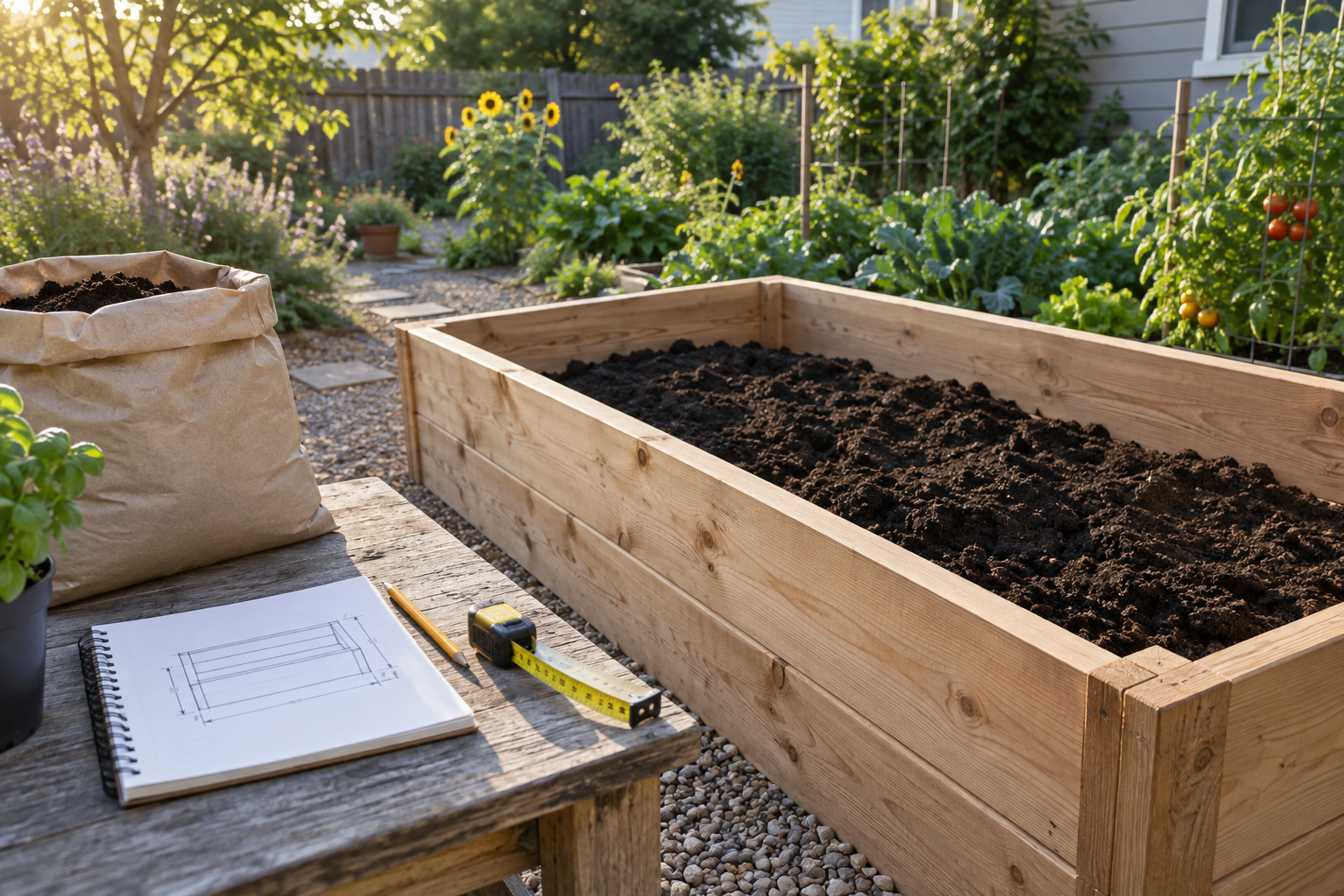
Start with a decision, not a bag count
The first useful question is not “How many bags should I buy?” It is “What empty space am I trying to fill?” Write down the inside length, inside width and added soil depth for each bed. The outside dimensions of a frame, a product name or a supplier’s usual pallet size are not measurements of the space that needs soil.
Separate a new fill from a top-up. If a bed is 12 inches tall but already holds 8 inches of usable soil, a 4-inch top-up is the quantity to calculate. That one distinction prevents a common mistake: buying a full bed’s worth of material twice. The planner accepts your missing depth directly, so there is no need to subtract existing soil elsewhere.
Make one entry for every meaningful difference
Use a separate entry when a bed has a different shape, inside size or fill depth. Use the identical-beds quantity only when those details are truly the same. This keeps the calculation readable after you leave the screen: a list of named entries can be compared to what is actually in the garden.
For example, one 4 × 8-foot bed filled by 8 inches and two 3 × 6-foot beds filled by 6 inches are not three copies of one job. Their measured spaces are different. The calculator can add them into one order, but it should show you where the total came from.
Convert the measured space before you look at prices
For a rectangular bed, multiply inside length by inside width by added depth. In imperial units, convert the depth from inches to feet first. A 4 × 8-foot interior filled by 8 inches needs 21.333 cubic feet: 4 × 8 × (8 ÷ 12). The same space is about 0.790 cubic yards or 604 litres.
Those are three labels for the same measured volume. A supplier may sell bags in litres, loose material in cubic yards, or bulk material in cubic metres. The planner keeps the physical volume consistent while displaying the units needed for each quote. A price is only meaningful once the product and volume unit are clear.
4 ft × 8 ft × (8 in ÷ 12) = 21.333 cubic feet
| What you are comparing | Example value | Why it matters |
|---|---|---|
| Measured volume | 21.333 cu ft | The empty space to fill |
| Bag size | 2 cu ft | Determines whole-bag rounding |
| Bulk increment | 0.5 cu yd | Determines the smallest bulk order step |
| Delivery fee | $45 | Changes the total, not the volume |
Keep the measurement, allowance and rounding separate
A measured volume comes from the bed. An allowance is an extra percentage you choose for a stated reason. Rounding happens because a supplier sells whole bags or fixed bulk increments. They are three different things, and combining them into one unexplained “extra” makes an order hard to check.
Suppose the 21.333-cubic-foot bed has a 10% purchase allowance. The target becomes 23.467 cubic feet. With 2-cubic-foot bags, that rounds to 12 bags, supplying 24 cubic feet. The 2.667 cubic feet above the measured bed is made of 2.133 cubic feet from the chosen allowance and 0.534 cubic feet from whole-bag rounding.
If you decide not to use an allowance, set it to 0%. The calculator does not claim to predict settling, compaction or a particular soil product’s behavior. It makes your stated purchase decision visible.
Compare a complete bag quote with a complete bulk quote
A bag quote needs the volume per bag, price per bag and any delivery charge you will actually pay. A bulk quote needs the price per quoted unit, supplier minimum, order increment and delivery fee. Do not compare a bag’s shelf price with a bulk material price alone; the final partial bag, half-yard step and delivery charge can reverse the result.
For the 21.333-cubic-foot example, 12 bags at $8 each cost $96 before any bag delivery. The volume is 0.790 cubic yards, which rounds to 1.0 cubic yard when a supplier sells in 0.5-yard increments. At $60 per yard with $45 delivery, the bulk order costs $105. At these illustrative quotes, bags cost $9 less, even though the bulk material has a lower unit price.
Change one real quote at a time in the planner. When both costs are entered, it reports the difference at your chosen increments. The result is a comparison of the inputs, not a recommendation about soil quality.
0.790 cu yd → 1.0 cu yd bulk order; $60 material + $45 delivery = $105
Combine orders only when you can use the remainder
A single order for several beds can reduce rounding waste. Two beds requiring 3.2 cubic feet each need eight 2-cubic-foot bags if bought separately, because each bed rounds to four bags. Together they need 6.4 cubic feet and round to seven bags. The combined order supplies 14 cubic feet rather than 16.
That saving only applies if the two beds can share the same material, delivery and opened bags. Separate jobs may need separate orders because of timing, storage, different products or an inability to move a partly used bag. Enter beds together when that reflects the purchase you can actually make, not simply because a smaller number looks better.
Check the delivery before you submit an order
Write down where material will be dropped, how far it must move, whether the route has gates or stairs, and whether the supplier has access limits. These details do not change the volume calculation, but they can change the product, delivery fee or practical quantity you choose to order. Keep them with the printed plan rather than relying on memory during a supplier call.
Confirm the product name, net volume or bulk unit, minimum delivery quantity, order increment, delivery fee and taxes. If a label gives only weight, do not treat it as an interchangeable volume without product-specific information. The calculator estimates space; it does not infer bulk density from a weight label.
Use a simple final review before paying
Read the plan from top to bottom: each bed name and inside measurement; the added depth; any explicit allowance; the total measured volume; the rounded bag count or bulk quantity; and every price or delivery assumption. If a number cannot be explained, correct it before purchasing.
Save the plan on your device or print it with the quote details. If the supplier changes the bag size, bulk increment or delivery fee, update that field and recalculate. A good soil order is not one that never changes; it is one where each change has a visible effect you can check.